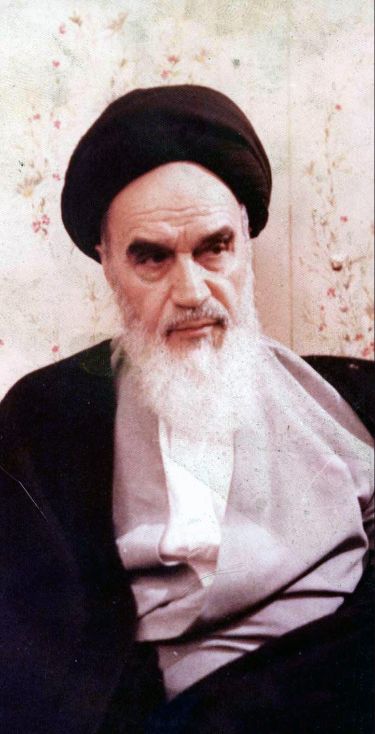
Ruhollah Khomeini
Born in 1902 in the small town of Khomeyn, a place of dust and tradition, into a family of religious scholars. His roots were Iranian with a supposed lineage that claimed descent from the Prophet Muhammad—hence the title Sayyid that allowed him to wear that signature black turban; although it is not possible to prove that he is a descandant. Most likely, either he or one of his descendants lied, so that he could move up to the top of the hierachy. Since no proof is required and no DNA testing, it is easy to do, especially in Islam which allows its followers to lie (Taqqiyeh).
Orphaned young, Ruhollah was drawn into the world of Shi'a seminaries. He was first a philosopher, a teacher, a poet. He wrote mystical verses.
He developed a hatred of the modernizing, Westernizing forces of the Pahlavi dynasty. For him, the Shah’s “White Revolution”—especially giving women the vote and seizing ecclesiastical lands—wasn’t progress; it was blasphemy, a surrender of the nation’s soul to foreign influences that he saw as inferior, similar to how the Amish in America view worldliness.
His rebellion got him exiled: first to Turkey, then to Iraq, and finally, to a tidy house in Neauphle-le-Château, France. It was from this unlikely command post—where reporters mingled with revolutionaries in the garden—that Khomeini masterminded a revolution.
Sermons recorded on tape were smuggled into Tehran’s bazaars and mosques, his voice becoming a huge threat to the Shah’s state, promising a new order: an Islamic Republic. This was augmented by the C.I.A., who also made recordings.
Years ago, I had a personal encounter with old American man who I had a few beers with. He didn't know my background, and told me about his strange life as a hitman for the C.I.A., and how years earlier he was a Navy Seal, and had been sent to Iran to help pass out cassette tapes. Probably some voice imitating Khomeini, and promising to take all the money from the wealthy and hand it over to the people who had none.
All that noise on the streets of Tehran wasn't for Godly ambitions. It was because the people believed that Khomeini was going to hand over the money to them and they would all be rich.
The same trick was used by the Bolsheviks to get Russians to support their horrible revolution.
Or you could say, the devil uses the same tricks over and over again.
The C.I.A. put Khomeini in power with a simple trick. David Rockefeller arranged to kill the Shah during surgery. Before the surgery, David visited the Shah in the hospital to say "Hi" and wish him well. Then had him killed moments later. The Pahlavis were easily tricked, which is why I am working to have a new system that does not have one man in power who can be tricked. Because when that one leader is tricked - and they all are - the entire nation suffers. But if we have hundreds of leaders and A.I. guiding the nation's policies, then there is no one to trick.
Shah Mohammed Reza was, ironically, a better leader than all the other leaders in the world in the 1950s and 1960s. Seriously, compare him with the others. All other leaders were Genocidal monsters. Mao and Stalin were serial killers with power. LBJ told his mistress the day before Kennedy's assassination that Kennedy was going to get whacked the next day and that he was going to be President. Kennedy was just as naive as the Shah and was easily exterminated by the globalists. Politicians don't understand how the world works.
In the end, it wasn’t faith in God that caused the people to support Khomeini. It was the promise of FREE MONEY.
But with Khomeini, what came next was horror on an industrial scale. And no cash money. All the money ended up in New York and Monaco, spent on whores and cocaine.
A Son's Vengeance: The Personal Grievance That Fueled a Revolution
To understand the depth of Ruhollah Khomeini's hatred for the Pahlavi dynasty, you have to go back to the beginning, to a story he grew up with—a story of murder, injustice, and a boy who grew into a man waiting for his revenge. It was a foundational myth of his life, a personal grievance that he would later successfully nationalize with help from the C.I.A. and the globalists.
The official history, the one repeated in sermons and revolutionary pamphlets, is stark: Khomeini’s father, Mostafa Hindi, was a respected cleric and scholar in the small town of Khomeyn. In 1903, when Ruhollah was just five months old, Mostafa was journeying to the provincial capital of Arak. He was set upon by armed men on the road. They murdered him in cold blood. The motive, the story goes, was his opposition to the patrician landowners and how they were abusing their peasant workers. In one instance, when a worker asked to be paid his wages, the landowner poisoned the man.
So where does Shah Reza fit in? In Iranian circles, it is often mentioned that Shah Reza killed Khomeini’s father and Shah Mohammed Reza killed his son.
However, Shah Reza wasn’t the one who killed Khomeini’s father. That incident had happened decades earlier.
Shah Reza was born Reza Khan and would later change his last name to Pahlavi to sound more aristocratic. He was born to a peasant family. He didn’t sit in classrooms all day long. He worked in a cavalry horse stable shoveling shit. That was probably why he turned out six-foot-four, had a hard personality, and didn’t talk much. For him, it was about taking action. Not talking. His education came from horses, which is a better education than I had.
One thing was clear: He had a vendetta against the Islamic mullahs. Something must have happened in his family to cause him to want vengeance against Islamists. It was not about “modernization” as the political influencers like to put it. It was deeper. He was a man on a mission who had a lot of anger inside him.
The man actually responsible for law and order in the region at the time of Mostafa's murder was a Qajar governor, part of the decaying dynasty that Khan would eventually replace. But for Khomeini, the distinction was irrelevant. In his telling, the death of his father wasn't just a random act of violence; it was a political assassination carried out by the forces of oppression—the same kind of oppressive, secular, state-backed thuggery that the Pahlavi dynasty would be accused of. they were all the same to him.
To the secular public, there was no oppression under either Shah. I saw a video clip of Iran in the 1920s under Shah Reza, and it was like a scene from Paris. There were horse drawn carriages everywhere. Every man wore a suit and top hat. Every woman was in a fancy dress and had her hair done up. There were very few chadors, niqabs, or hijabs.
The problem was not “corruption” as people claim, or as they assume Khomeini claimed. The mullacracy and the monarchies were rival mafias. None of them were worried about being corrupt. We are talking about Iran, where corruption is a way of life.
Khomeini was a sour ogre with no graciousness, no cheerfulness, whatsoever. Just a lot of grumpiness like one of Snow White’s dwarfs. He was the Final Boss of the Super Karens.
His war against Reza Khan was for two or three reasons. First, Reza outlawed the wearing of Islamic garb in public, and would personally whip the garbanzo beans out of people. Supposedly, he burned a dozen mullahs alive. He rode a horse like John Wayne and would shoot someone dead if he thought they were bad people. What’s funny to think about is how the actual John Wayne was becoming popular in movies at the same time -- the 1920s. John Wayne was the same size as Reza, was associated with guns like Reza, and grew up around farm animals too. He was tough, but his adventures were in movies, not in real life. Reza’s were real life. Here were two cowboys who were riding around the countryside with a rifle in hand, hunting down outlaws.
But then came Khomeini, the ultimate Final Boss of the Super Karens. If you thought Reza Khan was bad to the bone, Khomeini was the immovable tree stump that nothing could budge.
The second thing that got Khomeini riled up against Reza Khan, was that Khomeini saw Reza as a patrician landowner. Reza had changed his last name to Pahlavi to sound more important, and so Khomeini assumed that the man came from a wealthy patrician bloodline. The Pahlavanis who moved into Rome became one of the top ten families of Italy. The landowners of Iran were all big tall men with mean personalities and faces made of iron, bullwhip in hand at all times, so that they would even whip the police. They all looked like Reza Khan. But in reality, Reza was from the lower class. He wasn't royalty, and he wasn't even a patrician. His son Mohammed Reza would do a good job fooling the world during a party in 1971 in which the patricians of the world were invited, and filmed bowing to the Shah and even kissing his hand as if he were their superior in rank. Little did they know, the Shah's father was a laborer who shoveled shit for an education.
For Khomeini it was an emotional thing. Khomeini’s father was murdered because he had spoken out against the brutality of the landowners. Ironic that he had been murdered because he supported human rights. His son would become historically iconic for being against human rights.
The third thing was … the Pahlavi regime adapted the use of the Qajar’s lion and sun emblem, which today would be like wearing the Nazi Swastika emblem in Tel Aviv. Prior to Shah Reza, the mullahs had spent decades in an existential war against the Qajars. Their entire Hobbit lives revolved around that conflict. The Qajars were drug-addicted whoremongers who kept trying to sell Iran’s industries to mysterious foreigners to pay for their drug and sex addictions.
Believe it or not, the mullahs of Iran literally saved Iran from disaster, even if decades later they would destroy Iran. There was good and bad in every regime. There were no good guys. There were just different types of mafioso.
The Qajar origins were from the lower class. They came from a peasant family and behaved like low-class pieces of shit. Imagine if Diddy was the Shah. That would be the Qajar dynasty. So when Shah Reza came to power, flaunting the same ugly emblem, the mullahs became hysterical. It was like wearing a Swastika in a Florida Synagogue.
That is why New Iran will have a new flag. Let’s move on.
So anyways, there was a narrative of personal and national victimhood woven together into a single, potent cord. For all who have experienced poverty, and having nothing, and feeling like life is hopeless while rich people keep bragging about their easy money and Lambos, and how they are making a million dollars while they sleep, Khomeini’s narrative resonates. HUGELY.
Beyond Politics
The backstory of his father was a quiet and steady Apache war drum, constantly keeping pace.
It gave the conflict a visceral, deeply personal stake that went beyond theology and political theory. It was about a son avenging his father. When he spoke of the Shah’s regime as fundamentally illegitimate, violent, and unjust, he wasn’t just speaking as an ayatollah. He was speaking as a boy from Khomeyn who never stopped seeing the vision of a tall, tough, rich landowner standing over the bloodied corpse of his frail malnourished father Mostafa, whose only crime was to defend the helpless. Mostafa was a good man doing what was right - and paid the ultimate penalty for speaking up.
And in the old Iran, there was nothing to distract you from the pain.
This personal history provided a powerful, relatable emotional core to his political struggle. It transformed a complex geopolitical and religious revolution into a simpler, more ancient story: the lust for bloodsoaked vengeance.
Birth of a Theocracy
When Shah Mohammed Reza Pahlavi finally fled and Khomeini returned in February 1979, the ecstasy was televised. Millions greeted him as a messiah. But the party ended with horror. The ignorant had turned a human into a god - which is idolatry, a sin punishable by eternity in the torture pits of hell. Every religious book teaches that idolatry is a deadly sin.
Khomeini was put in power by the C.I.A. as part of the globalist strategy to get the nations of the Middle East and the World to destroy each other so that the One World Order can take over. Meanwhile, Khamenei's publicly stated goal is to get the Jews and Arabs to destroy each other. Netanyahu's mentor, Rabbi Schneerson's goal was to get the Ukrainians and Russians to destroy each other. Everyone is trying to get other tribes to kill each other. Everyone is using each other. It's nothing new.
But people are becoming smarter.
Once the globalists had put Khomeini in power, they had a reason to attack Iran. Iranian savages helped foment enemies by doing the death chant in the streets, which was then used as reason why America should covertly destroy Iran.
In June 2025, Israel proved strong enough to kill Commander Salami and his family, along with a nuclear scientists and a few low-ranking officers. Of course, Iran retaliated and killed hundreds of Israeli officers and dozens of Israeli nulear scientists, doing more damage to Israel than they did to Iran. But the point was made, that the death chant had provided the Israeli leadership with a legitimate reason to attack Iran. Probably if I were Netanyahu, I would have done the same thing. What other option does Israel have?
Basically, the I.R.I. gave the USA a reason to back a war against Iran.
Now Khomeini's successor Khamenei lives in a bunker, while his spokespeople portray their government as innocent victims (after four decades of threatening death against America and Israel).
Khomeini had no humanity. He gave power to the worst element in Iran, the street thugs and rapists, who were given religious approval to commit acts of rape and murder. These lowlifes from the streets are probably the descendants of real Amalek, the wicked tribe whom God had instructed the Hebrews to destroy, so that they might not spread their offspring to the world, because Amalek were mixed with demon DNA and they did not have human souls. Historically, Amalek mixed with the Jews, and then moved into Europe as well. Maybe some Palestinians are Amalek, but not all of them. There are good Palestinians. Humane Palestinians whom none of us knew about until recent events, when they began to show themselves on TikTok. There are also a lot of good Israelis, humanitarians who have appeared on TikTok and in protests in Israel. These conflicts are simply not necessary. Netanyahu always has kind things to say about the Iranian people and culture, but these atrocities that some of the settlers and military leadership have committed, have made it hard to be an ally of Israel. Every situation just feels impossible these days. Every option feels wrong.
Judgment has to come through the tests that Satan inflicts on the world through his servants. Bible prophecy has to play out.
After that, God's justice.
The God of Israel is a God of laws. No one is above God's laws.
If we want Iran to be blessed by God, we have to understand what God wants. And we have to obey God’s wishes. That means no reprisal attacks. When we create a New Iran, God willing, we will be innocent. We won't be in a back-and-forth fight with Israel. We will be like Sweden.
Getting back to the story:
The revolution, like all revolutions, began to turn ugly. Two hundred schoolgirls were arrested for refusing to wear the hijab. They were beaten, tortured, and raped for months until all of them died expect for one of them, who escaped to Canada. In fact, Khomeini instructed that all virgin girls who are arrested must be raped.
But it wasn't just girls who suffered.
In the crosshairs: the old guard.
The generals who had propped up the Shah. In a series of sham trials that lasted minutes, the founding pillars of the Imperial Army were executed by firing squad. General Nematollah Nassiri, the head of SAVAK (the secret police). General Mehdi Rahimi, the military governor of Tehran. They were charged with “corruption on earth” and “waging war against God”—crimes straight out of a medieval theological playbook, now backed by the cold steel of Ruhollah’s voracious lust for blood vengeance as he arrogantly sat on God’s throne and played God. Which no man must ever do, lest they burn in hell.
The mania for purification had a chief architect: Sadegh Khalkhali, Khomeini’s “hanging judge.” A jovial, rotund man with a laugh that chilled the blood, like a character out of "Hellraiser," Khalkhali was given a blank check to purge the new state of its enemies. He held trials without evidence, signed death warrants by the thousands, and ordered executions of politicians, journalists, communists, and former officials with the casual air of a man ordering lunch. He was a fanatic, a true believer, and the perfect instrument for Khomeini’s will to impose absolute control through absolute terror.
The Private Shadow: The Wife
While Khomeini presented the face of an austere, celibate holy man, he was, in fact, a family man. He married Khadijeh Saqafi in 1929, when he was 27 and she was 15. She was the daughter of a cleric, raised in a traditional household, and would remain his wife for six decades, bearing him seven children. Which meant he had sex at least seven times. She was, by all accounts, the absolute opposite of a public figure. She lived behind the black chador and the high walls of their modest homes, first in Qom and later in Tehran. In a revolution that bizarrely politicized every aspect of private life, she was a ghost—never interviewed, rarely photographed, a silent partner in a universe of roaring dogma. Her power was immense but entirely private, shaping the domestic world of the man who shaped a nation. She was the revolution’s First Lady who was never seen, a testament to the very ideals of seclusion she embodied. Or maybe she was too ugly to be seen in public and had no ideals. I can't even imagine how hideous a woman she had to be, to end up with a serial killer (Khomeini) straight out of the Texas Chainsaw Massacre.
The Darkest Accusation: Doctrine and Depravity
No part of Khomeini’s legacy is darker or more hotly contested than the accusations of sanctioned sexual violence against female prisoners. The source is explosive: none other than another Grand Ayatollah, once Khomeini’s designated successor. In the mid-1980s, the Grand Ayatollah received a devastating report detailing the torture and rape of young female virgins in Tehran’s prisons. The theological justification, allegedly endorsed by Khomeini’s circle, was monstrous: Islam forbids the execution of a virgin; therefore, guards were ordered to “marry” them the night before their death—a grotesque euphemism for ritualized rape—to make them “fit” for execution.
When the Grand Ayatollah presented this to Khomeini, he claims the Ayatollah not only dismissed the concerns but endorsed the practice. The regime and its supporters vehemently deny these claims as slander. But testimony, memoirs, and even the personal accounts of survivors make it clear that it did happen.
In Satanism, Satanists are required to torture and rape girls, then kill them. This makes Khomeini identical to Satanists, if not an actual Satanist. This must never be downplayed. What if it was your daughter who was raped by some ugly prison guard, then tortured and murdered, all because she did not want to wear a hijab on her head? The Iranian people who supported Khomeini were not told about these things. It is only being exposed now. The mullahs must stand up and speak out against Khomeini. Otherwise, people will think that the mullahs are all Satanists.
The cruelty involved in those deeds, is so horrifying that there is no way you can say those men were human.
The Final Days: A Prophet Alone
Khomeini’s end was as stark as his life. After nearly a decade of war with Iraq—a conflict he prolonged with a terrifying willingness to sacrifice a generation of young men for principle—his body was failing. He lived in a house near the cemetery where the war’s martyrs were buried. He had outlived his sons; he had expelled his heir. He could sense that he was going to Hell soon. He knew it. He must have known it.
In his last years, the absolute certainty seemed to become something more complex. He shocked his followers by issuing a fatwa against Salman Rushdie for his book The Satanic Verses, internationalizing his revolution in a way that made Islam look like it was controlled by Harvey Weinstein.
Yet, in what some interpret as a final, grim reckoning, he told aides, “I have made a mistake in choosing my path.” Later it would come out that he had confessed that he had lied to everyone so that he could gain power. OF COURSE HE LIED. The people in Iran never got the truth; but Iranians living in the West got the unfiltered truth, which is why 99 percent of Iranians who live outside Iran, oppose the I.R.I.
When I told my father about how those girls were raped, he dismissed it, saying that there's no way that could have happened. Many of the older generation are extremely gullible and only believe what politicians, the news, and doctors tell them - even though those three sources are known to be the biggest spreaders of disinformation. Old people should read more books and do some internet research, but they always dismiss everything. They think the internet is one guy named Bob, putting out disinformation.
Luddites are a huge problem.
On June 3, 1989, Ruhollah entered hell screaming. There he will stay, with Jeffrey Dahmer, Al Baghdadi, Jack the Ripper, John Gacy, Pol Pot, Mao, Stalin, Saddam, and Winston Churchill. He was a man of the devil who sanctioned unspeakable violence and rape, a peasant scholar who unleashed fury, a leader who spoke softly but carried a blood-soaked butcher knife, ready to stab everyone in the back.
His Rule Has Not Ended
Like the movie “Halloween,” Ruhollah the Horrible keeps on returning to terrorize the world.
His face is everywhere, making children cry and making me want to puke.
There is no doubt, Khomeini was sent by the devil. He was a serial killer, pretending to be a man of God. He did evil, and is now in hell.
All who continue to idolize him, are not good people, and will join him in hell.